Updated November 11, 2026
Jackery generators are battery-powered portable power stations, not gasoline engines. Each one stores energy in a lithium iron phosphate (LiFePO4) battery, delivers it through standard 120V outlets and USB ports, and recharges from a wall outlet, a car or Jackery's SolarSaga solar panels. Pair a station with a panel and Jackery calls the kit a solar generator.
This guide covers the full 2026 lineup that Outbound Power sells: ten Explorer models from the 99Wh Explorer 100 Plus to the 5,040Wh Explorer 5000 Plus, five HomePower models built for home backup, the FridgeGuard, and the SolarSaga panels that charge them. Every specification below comes from our product pages, which follow Jackery's spec sheets, and every price is our live price as of November 11, 2026.
If you already know what you need, the comparison table and the Quick Answer will get you to the right model in a minute. If you are new to battery power, the sizing section explains how to match capacity and output to what you want to run.
For most buyers the Jackery Explorer 1000 v2 is the right first Jackery generator: 1,070Wh, 1,500W, 23.8 lb and $499. For home backup, the Jackery HomePower 3600 Plus gives you 3,584Wh, 3,600W and a 30A outlet in one expandable unit. For 240V appliances and whole-home circuits, step up to the Jackery Explorer 5000 Plus.
Jackery uses the word generator for two things. The Explorer and HomePower power stations are battery packs with an inverter: they store electricity and turn it into household AC power, with no engine, fuel, exhaust or noise beyond a cooling fan. A Jackery Solar Generator is one of those stations bundled with one or more SolarSaga solar panels, so the battery can recharge from the sun.
Inside every current model is a LiFePO4 battery. Compared with the older lithium-ion cells in the original Explorer 1000, LiFePO4 lasts far longer (Jackery rates most current models for 4,000 to 6,000 charge cycles while keeping at least 70% capacity) and tolerates heat better. A 4,000-cycle battery used every day is still useful after a decade.
What a Jackery cannot do is run indefinitely. Once the battery is empty, you recharge it from the wall, a vehicle, solar panels or a conventional generator. That is why the two numbers that matter most are capacity in watt-hours (Wh), which sets how long it runs, and output in watts (W), which sets what it can power. We cover both in the sizing section below.
Outbound Power has been an authorized Jackery dealer since 2022. Our original introduction to Jackery explains the company's background; this guide is about choosing the right model today.
Here is every Jackery power station we sell, from smallest to largest within each series. Capacity is the rated battery size, output is the continuous AC rating with the surge rating in parentheses, and solar input is the maximum the station accepts from panels.
| Model | Capacity | AC output (surge) | Solar input | Weight | Price |
|---|---|---|---|---|---|
| Explorer 100 Plus | 99.2Wh | None (USB only, 128W) | 100W | 2.13 lb | $109 |
| Explorer 300D | 288Wh | None (USB and 12V, 300W) | 100W | 5.51 lb | $209 |
| Explorer 300 v2 | 288Wh | 300W (600W) | 100W | 8.16 lb | $269 |
| Explorer 500 v2 | 512Wh | 500W (1,000W) | 200W | 12.6 lb | $359 |
| Explorer 600 v2 | 640Wh | 500W (1,000W) | 200W | 14.1 lb | $499 |
| Explorer 1000 v2 | 1,070Wh | 1,500W (3,000W) | 400W | 23.8 lb | $499 |
| Explorer 1500 v2 | 1,536Wh | 2,000W (4,000W) | 400W | 32 lb | $849 |
| Explorer 1500 Ultra | 1,536Wh | 1,800W (3,600W) | 800W | 38.6 lb | $1,079 |
| Explorer 2000 v2 | 2,042Wh | 2,200W (4,400W) | 400W | 39.5 lb | $899 |
| Explorer 5000 Plus | 5,040Wh | 7,200W (14,400W) at 120V or 240V | 4,000W | 134.5 lb | $3,149 |
| HomePower 1000 v2 | 1,024Wh | 1,500W (3,000W) | 400W | 23.4 lb | $549 |
| HomePower 1000 Plus v2 | 1,024Wh | 1,800W (3,600W) | 400W | 23.8 lb | $639 |
| HomePower 2000 Plus v2 | 2,048Wh | 2,400W (4,800W) | 800W | 41.4 lb | $1,069 |
| HomePower 3000 | 3,072Wh | 3,600W (7,200W) | 1,000W | 59.5 lb | $1,349 |
| HomePower 3600 Plus | 3,584Wh | 3,600W (7,200W) | 1,000W | n/a | $1,709 |
Specifications from our product pages, which follow Jackery's spec sheets. The Explorer 100 Plus and Explorer 300D have no AC outlet; their output figures are USB and DC totals. Our HomePower 3600 Plus page does not list a weight (n/a). Prices are for the station alone as of November 11, 2026.
Two models we list are not orderable today: the Explorer 300 Plus and the HomePower 3600 Pro Max, Jackery's 4,000W, 240V HomePower unit. We have left both out of the table and the recommendations until they are back.
The Explorer series is Jackery's portable line. The HomePower series uses the same battery chemistry and similar cases, but it is designed around home backup: expansion batteries, UPS switchover, load priority in the app and, on the 3600 Plus, a 30A outlet and a 240V expansion port. The table below shows where the two series differ.
| Feature | Explorer series | HomePower series |
|---|---|---|
| Main job | Portable power for camping, RVs, job sites and short outages | Home backup that also travels |
| Capacity range | 99.2Wh (100 Plus) to 5,040Wh (5000 Plus) | 1,024Wh to 3,584Wh, expandable with battery packs on the Plus models |
| Expansion batteries | Explorer 5000 Plus only (up to 30,240Wh) | 1000 Plus v2 (to 11kWh), 2000 Plus v2 (to 12kWh), 3600 Plus (Battery Pack 3600 Plus) |
| UPS switchover | Under 10 ms on the 300 v2, 500 v2 and 600 v2; 20 ms or 0 ms on the 5000 Plus | 10 ms or less on the 1000 v2, 1000 Plus v2 and 2000 Plus v2 |
| 240V output | Explorer 5000 Plus only | HomePower 3600 Plus through its AC expansion port with a second unit |
| Battery | LiFePO4, 4,000 cycles to 70% on most models, 6,000 on the 500 v2 and 600 v2 | LiFePO4, 6,000 cycles to 70% on the 1000 v2, 1000 Plus v2, 2000 Plus v2 and 3600 Plus |
A simple rule: if the station will spend most of its life in a closet waiting for an outage, buy HomePower. If it will ride in a vehicle, buy Explorer. The Explorer 1000 v2 and HomePower 1000 Plus v2 are close enough in size and price that the choice comes down to whether you want expansion later.

The Jackery Explorer lineup runs from a pocket-size 100 Plus to the 5000 Plus, which is a home energy system on wheels. The five models with cards below are the ones we recommend most often, with the rest of the series covered in the table above and in the notes between the cards.

The Jackery Explorer 300 v2 is the smallest Jackery generator with a real AC outlet. It stores 288Wh and delivers 300W from two 120V outlets, with a 600W surge for a short start-up spike. At 8.16 lb it goes in a backpack or under a car seat.
It also works as a small uninterruptible power supply. Leave it plugged in with your router or CPAP connected and it switches to battery in under 10 milliseconds when the wall power drops.
Price at Outbound Power: $269 as of November 11, 2026. Jackery lists it at $299 on jackery.com today.
Best for: phones, laptops, cameras, drones and a CPAP on a camping trip, or a desk UPS at home.
What to Consider Before Buying

The Jackery Explorer 500 v2 nearly doubles the 300 v2's capacity to 512Wh and raises the output to 500W, with a 1,000W surge. Jackery rates the battery for 6,000 cycles to 70%, the longest cycle life in the Explorer line along with the 600 v2.
It recharges from the wall in about 80 minutes, or in about 60 minutes using wall and solar together. The under-10 ms UPS switchover and a 3kV surge protector make it a practical backup for a home office.
Price at Outbound Power: $359 as of November 11, 2026.
Best for: weekend campers, tailgaters and remote workers who need an all-day laptop and lighting battery.
What to Consider Before Buying

The Jackery Explorer 1000 v2 is the Jackery generator most people should start with. Its 1,070Wh battery and 1,500W output run a refrigerator, a microwave on a short cycle, power tools and all of your electronics, and it still weighs only 23.8 lb with a folding handle.
Emergency Super Charge refills it from a wall outlet in about an hour. Three 120V outlets, a 100W USB-C port and two solar inputs (400W combined) cover most setups. It is available in orange and black or dune white.
Price at Outbound Power: $499 as of November 11, 2026. Jackery lists it at $559 on jackery.com today.
Best for: car camping, RV trips, short home outages and anyone buying one Jackery to do a bit of everything.
What to Consider Before Buying

The Jackery Explorer 2000 v2 doubles the capacity to 2,042Wh and the output to 2,200W (4,400W surge), which is enough for a 1,500W space heater and a refrigerator at the same time, with room left for lights and a laptop. Jackery's claim for it is 2kWh of capacity in a case the size of older 1kWh units, and at 39.5 lb it is still a one-person carry.
It is the only Explorer below the 5000 Plus with a 5-year warranty. Our product page offers it alone, with an Extreme Guard carrying bag, or with one or two SolarSaga 200W panels as a solar generator kit.
Price at Outbound Power: $899 as of November 11, 2026.
Best for: RV owners, job sites and homes that want a single battery to carry a refrigerator and essentials through an overnight outage.
What to Consider Before Buying
The Explorer 100 Plus ($109) is a 99.2Wh USB-only battery that stays under the 100Wh carry-on limit most airlines allow, with two 100W USB-C ports and a 2.13 lb weight. It charges from a 100W USB-C charger in 1.8 hours and, with an adapter, from a 100W SolarSaga panel. The Explorer 300D ($209) is a 288Wh, 5.51 lb unit with two 140W USB-C ports and a 12V output but no AC outlet, for people who only need to charge devices.
The Explorer 600 v2 ($499) is a 640Wh version of the 500 v2 with the same 500W output and 6,000-cycle battery, at 14.1 lb. The Explorer 1500 v2 ($849) adds 2,000W of output and 1,536Wh at 32 lb, with a 1.3-hour wall charge. The Explorer 1500 Ultra ($1,079) has the same capacity with 1,800W of output, an 800W solar input (double the 1500 v2's), IP65 protection with the lids closed, and an output that is limited to 1,000W between 5°F and 14°F.

The Jackery Explorer 5000 Plus is Jackery's whole-home system. It stores 5,040Wh, delivers 7,200W at 120V or 240V from a NEMA L14-30R outlet plus four 20A outlets, and expands to 30,240Wh with five Battery Pack 5000 Plus units. With the Jackery transfer switch it can power a subpanel of household circuits.
It accepts up to 4,000W of solar, recharges from the wall in about 3.5 hours, and runs at 30 dB in quiet mode. At 134.5 lb it rolls on built-in wheels and is meant to stay in a garage or utility room.
Price at Outbound Power: $3,149 as of November 11, 2026. Our product page shows "Pre-Order Now. Shipments Resume November 28" as of November 11, 2026.
Best for: homes that need 240V for a well pump, central air or an electric range, and want battery backup that scales.
What to Consider Before Buying

HomePower models are the ones to compare if you are buying for power outages. The 1000 v2, 1000 Plus v2, 2000 Plus v2 and 3600 Plus have 6,000-cycle batteries, and the three Plus models expand with battery packs.

The Jackery HomePower 1000 Plus v2 matches the Explorer 1000 v2 in size and capacity but adds the two things home backup buyers ask for: expansion and faster output. Its 1,800W output has a 3,600W surge, and up to five Battery Pack 2000 Plus v2 units take the system to 11kWh.
Four 120V outlets are split into two groups so the Jackery app can shed non-essential loads when the battery runs low. The UPS switchover is under 10 ms, and a 1,600W wall charge refills the main unit in about 50 minutes.
Price at Outbound Power: $639 as of November 11, 2026. Jackery lists it at $749 on jackery.com today.
Best for: buyers who want a 1kWh battery today with a clear path to a 5kWh or 10kWh home system later.
What to Consider Before Buying

The Jackery HomePower 2000 Plus v2 is the mid-size home backup unit: 2,048Wh of capacity, 2,400W of output with a 4,800W surge, and expansion to 12kWh with Battery Pack 2000 Plus v2 units. Its 800W solar input is double the Explorer 2000 v2's, so a solar recharge takes half as long.
Like the 1000 Plus v2, its four outlets are in two groups with smart output priority, and it switches to battery in 10 ms when wall power fails. Our product page offers it alone or with battery packs and SolarSaga panels.
Price at Outbound Power: $1,069 as of November 11, 2026. Jackery lists it at $1,199 on jackery.com today.
Best for: homes that want a refrigerator, furnace blower, lights and electronics covered through a full day, with room to grow.
What to Consider Before Buying

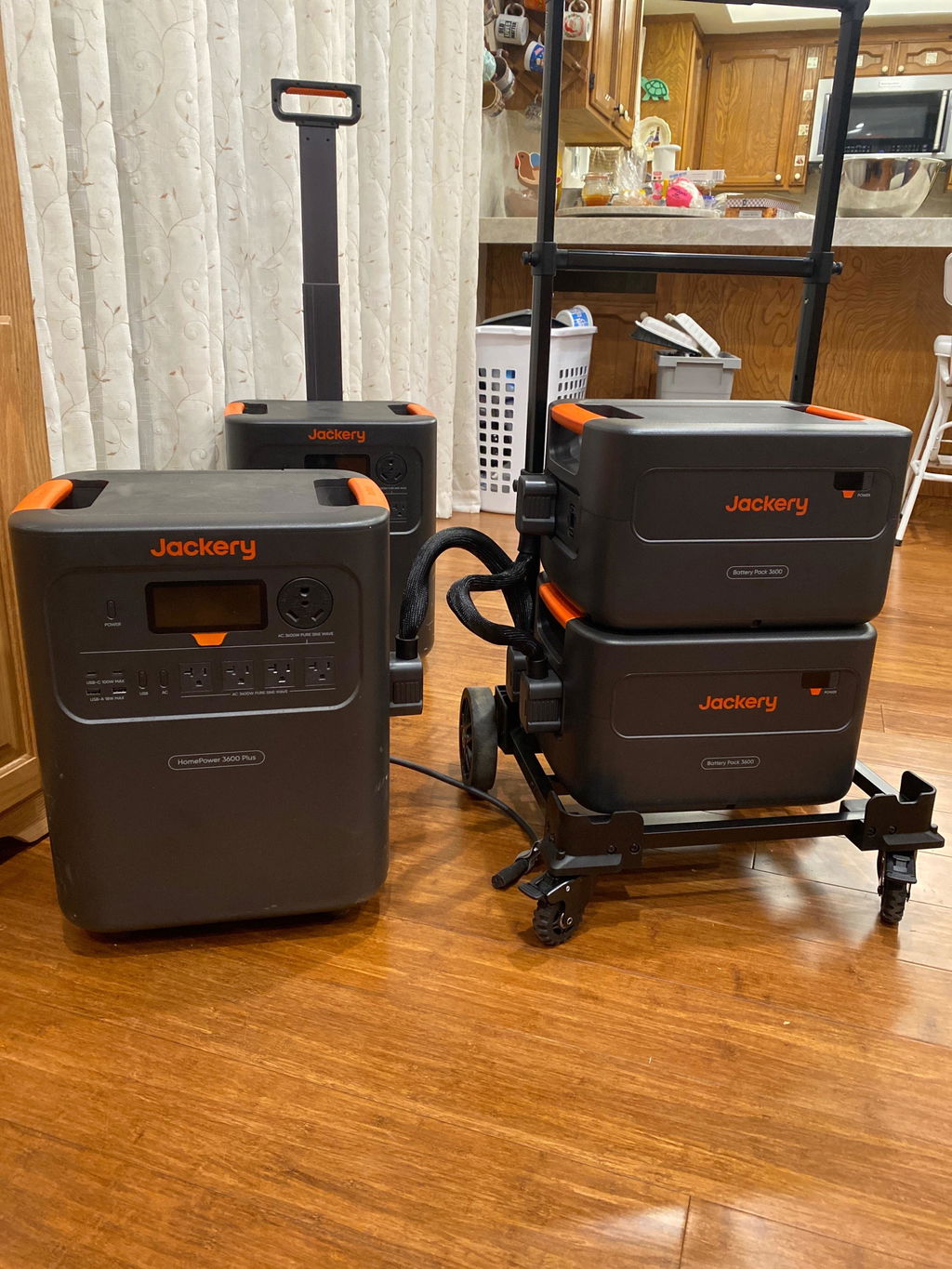
The Jackery HomePower 3600 Plus is the largest HomePower unit and our pick for most home backup buyers. It stores 3,584Wh, puts out 3,600W with a 7,200W surge, and has a 30A TT-30 outlet alongside four 20A outlets, so an RV's 30A shore power cord plugs straight in.
It expands with the Battery Pack 3600 Plus, and two units joined through the AC expansion port deliver 240V at up to 7,200W. Our product page offers it alone, with a SolarSaga 500X panel, with a manual transfer switch, or as a double kit.
Price at Outbound Power: $1,709 as of November 11, 2026. Our product page shows "Pre-Order Now. Shipments Resume November 22" as of November 11, 2026.
Best for: whole-home essentials backup, RV shore power and off-grid cabins that want one battery with a 30A outlet.
What to Consider Before Buying
The HomePower 1000 v2 ($549) is the non-expandable version of the 1000 Plus v2: 1,024Wh, 1,500W, three outlets, sub-10 ms UPS and a 6,000-cycle battery at 23.4 lb. If you are sure you will never add a battery pack, it saves money over the Plus. The HomePower 3000 ($1,349) sits between the 2000 Plus v2 and the 3600 Plus with 3,072Wh, 3,600W of output, a 30A outlet and a 1,000W solar input, but our product page lists no expansion battery for it.
The Jackery FridgeGuard ($779) is a different kind of product: a slim 1,024Wh, 800W battery that stands or wall-mounts beside a refrigerator and runs it on wall power until the grid drops, then switches to battery in about 10 ms. It has one outlet, expands to 2,048Wh with its own battery pack, and is sold as a pre-order; our product page shows the ship date.
A Jackery solar generator is simply a power station plus a SolarSaga panel, and on our product pages the panels are listed as options on each station. Choose the panel by two numbers: the station's maximum solar input, and how much weight you want to carry.
| Panel | Rated power | Weight | Type | Price |
|---|---|---|---|---|
| SolarSaga 40 Air | 40W | 1.98 lb | Folding, USB ports built in | $109 |
| SolarSaga 100W Air | 100W | 7.1 lb | Folding, 4 panels, IP68 | $249 |
| 100W Prime | 100W | 13.23 lb | Rigid glass, IP68 | $199 |
| SolarSaga 100 Light | 100W | 4.5 lb | Flexible, bifacial, IP68 | $249 |
| SolarSaga 200W | 200W | 14.33 lb | Folding, 4 panels | $379 |
Panel ratings are standard test conditions (STC); the bifacial Air, Prime and Light panels produce slightly more with light reaching the back. Prices as of November 11, 2026. The SolarSaga 500X, used with the 5000 Plus and HomePower kits, is not orderable on its own today.
Real solar output is lower than the rating. Jackery's own charging estimates assume good sun: the SolarSaga 100 Light charges an Explorer 100 Plus in about 1.4 hours and an Explorer 1000 v2 in about 12 hours with one panel or 3.2 hours with four. The Explorer 500 v2 takes about 200 minutes from its 200W input, and the HomePower 1000 Plus v2 about 3.3 hours from 400W. Expect longer in winter, in haze or with the panel flat on the ground.
Matching rules of thumb: a 40W or 100W panel suits the 300 v2 and the USB-only units. The 500 v2 and 600 v2 take one 100W panel or, at their 200W limit, one SolarSaga 200W. The 1000 v2, 1500 v2 and 2000 v2 accept up to 400W, so two SolarSaga 200W panels make a full-rate kit. The 1500 Ultra and HomePower 2000 Plus v2 take 800W, the HomePower 3000 and 3600 Plus take 1,000W, and the 5000 Plus takes 4,000W through its high-voltage input. If you want to compare Jackery kits with other brands, our solar generator kits collection lists every station-and-panel bundle we sell, and the solar panels collection covers panels from every maker we carry.
Older 60W, 100W and 200W SolarSaga panels use a DC7909 plug; current stations use DC8020, and Jackery's DC7909-to-DC8020 adapter joins the two. Angle the panel at the sun and move it through the day; a flat panel in the afternoon can give up half of its rated output.

Start with output. Add up the running watts of everything you want to power at the same time, then check that the largest motor load (a refrigerator compressor, a pump, a saw) starts within the station's surge rating. A 1,500W station handles a full-size refrigerator, a laptop, lights and a fan together. A 300W station handles electronics and a CPAP, not appliances.
Then size capacity. Divide the station's watt-hours by about 1.18 to allow for inverter losses, then divide by the average draw of your loads to get hours. A refrigerator that averages 150W over a day draws about 3,600Wh in 24 hours, so an Explorer 2000 v2 covers roughly half a day of refrigeration plus some lights, while a HomePower 3600 Plus covers most of a day and a 5000 Plus with one battery pack covers more than two. Jackery's own lab figures for the 5000 Plus are about 26 hours for a 90W compact refrigerator and about 4.5 hours for a 900W wall air conditioner.
Finally, decide how you will recharge. For short outages, wall charging before the storm is enough. For multi-day outages or off-grid use, add solar sized to the station's input limit, or plan to recharge from a vehicle or a gas generator. Our guide on how to select the right size portable power station walks through the arithmetic with worked examples.
Connecting to your home: plugging appliances into the station is safe. Feeding a station into house wiring requires a transfer switch or interlock installed by a licensed electrician, never a cord between the station and a wall outlet. Jackery sells a manual transfer switch, which our product page lists for the HomePower 3600 Pro Max, and an automatic transfer switch, which Jackery lists for the Explorer 5000 Plus and 3600 Pro Max series. Confirm compatibility with your exact model before you buy either one.
A gas inverter generator runs as long as you have fuel. A Jackery runs silently indoors, needs no fuel, oil or maintenance, starts instantly and can be left plugged in as a UPS, but it stores a fixed amount of energy. For a camping weekend, a home office, medical devices or a few hours of outage, the battery wins. For days without grid power and no solar, a generator or a hybrid of the two wins.
Many of our customers run both: a Jackery for quiet overnight power and sensitive electronics, and a gas generator to recharge it during the day. Our home backup power collection covers both approaches, and our portable power stations of 2026 guide compares Jackery with EcoFlow, Anker, Bluetti and others.
Jackery generators at Outbound Power range from $109 for the Explorer 100 Plus to $3,149 for the Explorer 5000 Plus as of November 11, 2026, with the Explorer 1000 v2 at $499 and the HomePower 3600 Plus at $1,709. Where Jackery's own site lists a higher price for the same item, we show it on the product card above.
Outbound Power is an authorized Jackery dealer, so every unit carries Jackery's warranty: 3 years on most Explorer and HomePower models, 5 years on the Explorer 2000 v2, Explorer 5000 Plus and HomePower 3600 Plus, and 2 years on the Explorer 100 Plus. Our Price Beat Promise means that if you find the same item at a lower price from an authorized U.S. dealer before you order, we beat it by 1%. Browse the full Jackery collection for every station, panel, battery pack and accessory, or the current Jackery Black Friday deals page for this season's reduced prices.
Not in the engine sense. A Jackery is a battery with a built-in inverter and charger. It generates nothing itself; it stores power from the grid, a vehicle or solar panels and delivers it later. Jackery uses "solar generator" for a station sold with panels, because the panels generate the power.
Any model with at least a 1,500W output starts and runs a full-size refrigerator, which is the Explorer 1000 v2 and up and every HomePower model. How long it runs depends on capacity: plan on roughly 150W average draw, so about six hours from a 1,070Wh station and most of a day from a 3,584Wh HomePower 3600 Plus. The FridgeGuard is built for exactly this job.
Jackery rates its current LiFePO4 models for 4,000 charge cycles (Explorer 300 v2, 1000 v2, 1500 Ultra, 2000 v2, 5000 Plus, HomePower 3000) or 6,000 cycles (Explorer 500 v2, 600 v2, HomePower 1000 v2, 1000 Plus v2, 2000 Plus v2, 3600 Plus) while keeping at least 70% of capacity. Used daily, that is 11 to 16 years before the battery drops to 70%.
For a weekend with phones, a laptop, lights and a fan, the Explorer 500 v2 or 600 v2. For a camp kitchen with a coffee maker or an electric cooler, the Explorer 1000 v2. For a travel trailer, the Explorer 2000 v2 or the HomePower 3600 Plus, which has the 30A TT-30 outlet an RV cord plugs into.
Yes. Current Explorer and HomePower models charge and discharge at the same time, and the models with bypass or UPS modes pass wall power straight through to your devices while the battery stays full. On the 1000 v2 the bypass mode passes 1,500W; on the 1500 Ultra, 2000 v2 and HomePower 3000 and 3600 Plus it passes 12A (about 1,440W).
Jackery says yes as long as the panel's voltage, current and connector match the station's input limits, and it recommends its own panels to get full performance and keep warranty coverage. Most Explorer and HomePower stations accept 16V to 60V on their DC8020 inputs; check the input specification on the product page before you connect a third-party panel.
The HomePower 1000 Plus v2 (to 11kWh with the Battery Pack 2000 Plus v2), HomePower 2000 Plus v2 (to 12kWh with the same pack), HomePower 3600 Plus (with the Battery Pack 3600 Plus) and Explorer 5000 Plus (to 30,240Wh with the Battery Pack 5000 Plus). The Explorer 1000 v2, 1500 v2, 1500 Ultra and 2000 v2 and the HomePower 1000 v2 and 3000 list no expansion battery on our product pages.
The Explorer 5000 Plus has 240V built in through its NEMA L14-30R/14-50 outlet. Two HomePower 3600 Plus units joined through the AC expansion port provide 240V. Every other current model is 120V only.
Buy the Jackery Explorer 1000 v2 if you want one Jackery generator for camping, road trips and the occasional outage. Buy the Jackery Explorer 300 v2 or Jackery Explorer 500 v2 if your loads are electronics and you want something light. Buy the Jackery Explorer 2000 v2 if you need to run a space heater or a refrigerator and a kitchen appliance together from a battery you can still carry.
For home backup, start with the Jackery HomePower 3600 Plus if you want a single unit with a 30A outlet and the option to expand, or the Jackery HomePower 1000 Plus v2 if you want to start small and add battery packs. Choose the Jackery Explorer 5000 Plus when you need 240V or a transfer-switch installation for whole-home circuits. Whatever you pick, add a SolarSaga panel sized to the station's input if you expect outages longer than a day.
Our power experts can size a Jackery station and panel set to your appliances and your outage history. Call or text 1-888-976-5443, Monday to Friday, 8 a.m. to 4 p.m. Arizona time, or email [email protected].
Shop Jackery Generatorsplaceholder