Updated November 15, 2026. Prices are our live storefront prices on that date.
Home backup power is any system that keeps part or all of your house running when the utility grid goes down. In 2026 that means one of three things: a whole-home battery wired to a smart panel or transfer switch, a standby generator on natural gas or propane, or a portable generator or power station you connect when the lights go out. The right choice depends on how much of the house you need, how long your outages last and whether anyone will be home to start it.
This guide is the hub for our home backup cluster. It explains what a complete system consists of, compares every type we sell, recommends six systems with live prices as of November 15, 2026, and walks through sizing, cost, recharging and installation. Our companion guide to the backup generators for home power outages ranks individual generators in more depth. This page is about the whole system.
Every specification here comes from our own product pages, which follow each maker's documentation. Where a maker does not publish a figure, the tables say “not listed” rather than guess.
A complete home backup power system has four parts, and the mistakes people make usually come from buying only the first one.
The connection matters more than most buyers expect. Plugging a generator or battery into a dryer outlet to feed the house, known as backfeeding, can energize utility lines and injure line workers, and it is illegal. Transfer switches and interlocks exist so that the house is connected to one source at a time. In the United States, optional standby systems fall under Article 702 of the National Electrical Code, and the switch or panel must be installed by a licensed electrician under a permit.

Six kinds of home backup power systems cover almost every home. The table compares them by what matters in an outage: whether the system starts itself, whether it can run 240V loads, how long it lasts and what has to be installed. Prices are the lowest live price of the example system as of November 15, 2026.
| System and example | Starts by itself | 240V | Outage length it suits | What gets installed | From |
|---|---|---|---|---|---|
| Plug-in power station DELTA 3 Max |
Yes (built-in UPS) | No | Hours to a day | Nothing | $879 |
| Power station with a transfer switch HomePower 3600 Plus kit |
Manual: no. Smart panel: yes | Yes, 6 to 7.2kW | A day or two; more with solar | Manual transfer switch or smart panel | $2,339 |
| Whole-home battery with a smart panel TITAN 5000 with panel |
Yes, under 20 ms | Yes, 7.2 to 12kW | Days with solar or a generator | Smart panel or gateway; batteries in a garage or on a wall | $4,290 |
| Home standby generator Generac 14kW |
Yes | Yes, 10kW and up | As long as gas flows | Pad, gas line and 200A automatic transfer switch | $5,081.30 |
| Portable generator with a transfer switch DuroMax XP13750HXT |
No, by hand | Yes | As long as fuel lasts | Manual transfer switch or interlock kit | $1,999 + switch |
| Hybrid: battery plus generator SOLIX E10 Infinite kit |
Yes | Yes | Days to weeks on generator fuel | Smart panel, batteries and a generator inlet | $7,399 |
The plug-in and portable-generator rows need no permanent installation. Every other row connects to your electrical panel and needs a licensed electrician, a permit and an inspection. Fuel-generator placement follows the CPSC guidance of 20 feet from the house for portables and the NFPA 37 clearance of 18 inches for standby units.
These six systems cover the tiers above, from a plug-in station to a whole-house standby generator. Every one is orderable from Outbound Power as of November 15, 2026, every specification comes from our product page for it, and each card says who should not buy it.
| System | Output | Storage | Switchover | Price |
|---|---|---|---|---|
| EcoFlow TITAN 5000 + Smart Home Panel 10 | 7,200W, 240V | 5 to 30kWh | Under 20 ms | $4,290 |
| Anker SOLIX F3800 Plus Smart Home Kit | 6,000W, 240V | 3.84 to 26.88kWh | Not listed | $3,599.99 |
| Anker SOLIX E10 Automatic Home Backup Kit | 7,680W, 240V (10kW for 90 min) | 6 to 30kWh | Under 20 ms | $5,799 |
| EcoFlow DELTA Pro Ultra X + Smart Gateway | 12kW, 240V | 12 to 61kWh | Under 20 ms | $9,364 |
| Cummins RS20A 20kW standby | 20kW, 240V | Gas supply | Automatic | $6,465.90 |
| Jackery HomePower 3600 Plus | 3,600W, 120V | 3.6 to 21.5kWh | Built-in UPS | $1,899 |
Storage is the range from the base system to the maximum on one inverter. Switchover is the maker's rating; the F3800 Plus Home Power Panel and the Cummins transfer switch do not list a figure.

The EcoFlow TITAN 5000 is a floor-standing 5kWh home battery with a 7,200W split-phase inverter built in. Paired with the EcoFlow Smart Home Panel 10, it switches up to 10 of your home's circuits to battery power in 20 milliseconds or less, and EcoFlow says it can start a compatible 3-ton central air conditioner without a soft starter. It is our overall pick because it covers the three things most homes need from home backup power: 240V, automatic switchover and room to grow from one battery to six.
The panel comes pre-wired from the factory, which keeps the electrician's work shorter than a traditional hardwired battery, and its CT clamps let the TITAN store surplus power from compatible rooftop solar through AC coupling with no export. One solar input accepts up to 4,000W of panels, and a generator can recharge the TITAN through its AC input during a long outage.
Price at Outbound Power: $3,199 on its own, $4,290 with the Smart Home Panel 10 (240V), or $6,533 with two batteries (10kWh) and the panel, as of November 15, 2026.
Best for: A home that wants automatic 240V backup of its essential circuits, including a compatible 3-ton air conditioner, with the option to add batteries and solar later.
What to Consider Before Buying

The Anker SOLIX F3800 Plus Smart Home Kit bundles a 3,840Wh, 6,000W power station with Anker's Home Power Panel and subpanel, so an electrician can turn a portable power station into a wired backup system for your essential appliances. Anker designed the panel to bring the F3800 Plus, the utility grid and rooftop solar together, with time-of-day and peak-shaving modes in the Anker app.
The F3800 Plus puts out 120V and 240V, so a well pump or a dryer circuit is possible as long as the load stays within 6,000W. Capacity grows with up to six expansion batteries to 26.88kWh on one unit, the panel has a second port for a second F3800 Plus or a 240V generator, and the Deluxe option adds eight 400W rigid panels for 3,200W of solar.
Price at Outbound Power: $3,599.99 for the Smart Home Kit, $6,266 for the Deluxe Smart Home Solar Kit with eight 400W panels, or $11,163 for the Premium kit with two stations, a Double Power Hub and sixteen panels, as of November 15, 2026.
Best for: A mid-size home that wants wired, app-managed backup for its essential appliances at a lower price than a whole-home battery, with a station that can still roll out to the RV or a jobsite.
What to Consider Before Buying


The Anker SOLIX E10 is a modular whole-home system: a 7,680W power module on top of one to five 6,144Wh battery modules, mounted on the floor or the wall, indoors or out. With two or more batteries it delivers 10,000W for up to 90 minutes and 155A of starting current, which Anker rates for a 5-ton central air conditioner.
Anker sells it as four kits. The Essential kit is the module and battery for plug-in or off-grid use. The Manual Home Backup Kit adds the Smart Inlet Box for a manual changeover. The Automatic Home Backup Kit adds the Power Dock, a 200A automatic transfer switch with 12 managed circuits and a switchover under 20 milliseconds. The Infinite Home Backup Kit adds the Power Dock and the Tri-Fuel Smart Generator 5500, which the system can start on its own to recharge the batteries.
Price at Outbound Power: $3,999 for the Essential kit (one 6kWh battery), $4,299 Manual, $5,799 Automatic ($7,799 with two batteries) or $7,399 Infinite, as of November 15, 2026.
Best for: A large home that wants central air, a well pump and the kitchen on battery, with a generator that starts itself when the batteries run low.
What to Consider Before Buying

The EcoFlow DELTA Pro Ultra X is the largest battery system we sell for a single home: a 12kW inverter with two 6,144Wh batteries to start, up to ten batteries (61.44kWh) on one inverter, and up to three inverters for 36kW and 184kWh. EcoFlow rates it for a 5-ton air conditioner with the proper setup, and it recharges from up to 10kW of solar.
The EcoFlow Smart Gateway connects it to your existing main panel through a 200A relay, so most of the house stays on without a panel swap, and its six smart circuits shed high-power loads to stretch the batteries. Its inlet box takes up to three units plus a 240V generator rated 3kW to 12kW. The EcoFlow Smart Home Panel 3 is the alternative for circuit-by-circuit control of 32 circuits. It is sold out on its own as of November 15, 2026, but it is available in our DELTA Pro Ultra X kits.
Price at Outbound Power: $7,899 with two batteries (12kWh), $9,364 with the Smart Gateway, or $10,849 with the Smart Home Panel 3, as of November 15, 2026.
Best for: A whole house, including central air, an EV and a workshop, on battery, with the main panel left in place.
What to Consider Before Buying

If you have natural gas or a propane tank and want the whole house back on without a battery, the Cummins RS20A is the standby generator we recommend. The 20kW air-cooled unit starts itself when the grid drops and hands the house back when power returns through an automatic transfer switch. The RS20AC option bundles a 200A service-entrance-rated switch.
It runs for as long as the gas supply lasts, stores no energy of its own, and at 65 dB(A) at 23 feet it is quiet for a generator. The trade-offs are a permanent outdoor installation, engine maintenance and the fact that it is never silent.
Price at Outbound Power: $6,465.90 for the RS20A, or $7,495.23 for the RS20AC with the 200A service-entrance-rated transfer switch, as of November 15, 2026.
Best for: A whole house with central air on natural gas, where nobody wants to think about batteries, fuel or starting anything.
What to Consider Before Buying

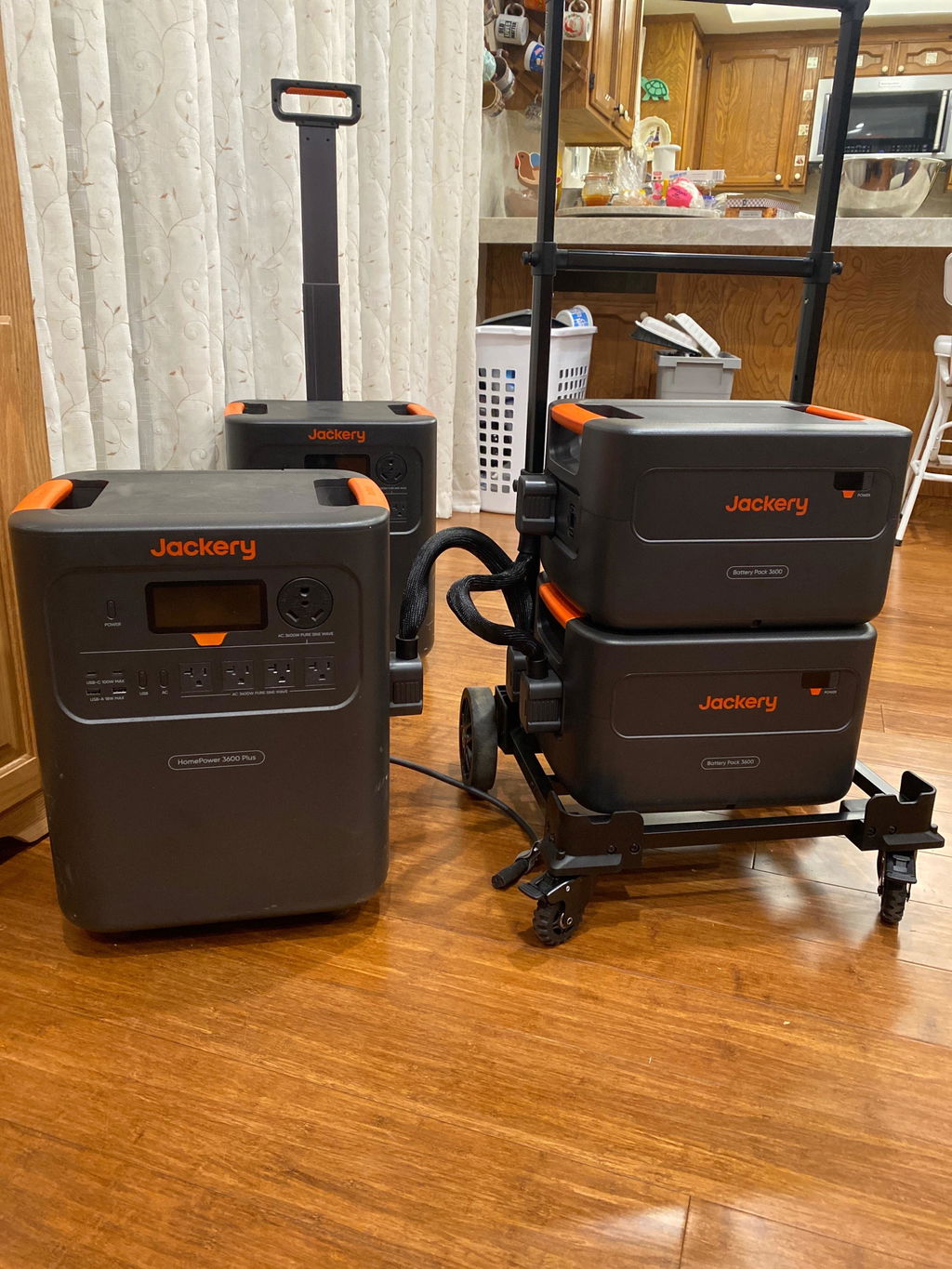
The Jackery HomePower 3600 Plus is the no-installation entry to home backup power. Plug the refrigerator, router, lights and a space heater into its outlets and it runs them from 3,584Wh of LiFePO4 storage with 3,600W of output, and its built-in UPS keeps computers and electronics up when the grid drops.
It stays 120V, so it will not run a central air conditioner or a 240V well pump, but it recharges from a wall outlet at up to 1,800W, from up to 1,000W of solar or from a generator, and up to five 3.6kWh battery packs connect with no wiring. Jackery's kit with a manual transfer switch is the route to wired circuits.
Price at Outbound Power: $1,899 (pre-order, shipments resume November 22), $2,339 with Jackery's manual transfer switch, or $3,979 for the two-unit Double Kit, as of November 15, 2026.
Best for: An apartment, a rental or a first step: refrigerator, Wi-Fi, lights and medical devices from a wall outlet, with no electrician.
What to Consider Before Buying
Browse the whole category in our home backup power collection, or go straight to the whole-home battery backup systems and home standby generators we carry.
Whole home battery backup means the battery system carries the house's circuits on its own, with no cords and no one home to flip a switch. Four things decide whether a battery system can do that for your house.
Central air, well pumps, electric dryers and most water heaters are 240V loads, so the inverter has to be split-phase 120V/240V. Every battery system in our recommendations except the HomePower 3600 Plus is. The harder test is starting current: an air conditioner's compressor draws several times its running current for a fraction of a second, and the inverter has to supply it. EcoFlow rates the TITAN 5000 for a compatible 3-ton unit, Anker rates the E10 at 155A LRA for a 5-ton unit with two or more batteries, and EcoFlow rates the DELTA Pro Ultra X for a 5-ton unit with the proper setup. Check the LRA figure on your condenser's nameplate against the system's rating before you buy.
Watts decide what runs; kilowatt-hours decide for how long. A refrigerator, furnace blower, lights, phones and a router use about 5 to 10kWh a day as planning figures, so a single 5kWh or 6kWh battery covers an evening and a night of essentials, and a 10 to 12kWh system covers a day. Central air changes the math: a 3-ton unit cycling through a hot day uses 20 to 40kWh, more than any single-battery system stores. That is why the whole-home systems are modular: the TITAN grows to 30kWh, the E10 to 30kWh per power module and the DELTA Pro Ultra X to 61.44kWh on one inverter.
Home battery backup without solar works. Every system here charges from the grid and holds that charge until an outage, and OASIS, Anker's app and Jackery's app can also charge off-peak and discharge at peak on a time-of-use plan. Solar changes what happens on day two of an outage. The TITAN 5000 accepts 4,000W of panels, the TITAN 5000 Plus 8,000W, the F3800 Plus 3,200W, the E10 9,000W and the DELTA Pro Ultra X 10kW, so a modest array can refill the batteries during the day and stretch a 10kWh system across a multi-day outage.
Existing rooftop solar is a different case. A grid-tied inverter shuts down when the grid fails, so it cannot help during an outage on its own. The TITAN with the 240V Smart Home Panel 10, and the DELTA Pro Ultra X with a current transformer on the Smart Gateway or Smart Home Panel 3, can store surplus rooftop production through AC coupling while the grid is up, and the installer confirms inverter compatibility. The BLUETTI EP900 is the grid-tied alternative we carry, a 9kW hardwired system with 9.9 to 19.8kWh of B500 batteries that integrates with a new or existing array; it is sold out as of November 15, 2026, so ask us about availability before planning around it.
The TITAN (IP20) and the DELTA Pro Ultra X (IP54) are indoor systems for a garage, basement or utility room, and both have charging temperature limits that start at 32°F and -4°F respectively. The Anker SOLIX E10 is NEMA 4 rated and mounts on a floor or a wall indoors or out, from -4°F to 131°F. Plan the location with the installer before you order: the batteries weigh 83 to 130 lb each, and the panel, inlet box and conduit runs all have distance limits. For a side-by-side of the two EcoFlow systems, read our EcoFlow TITAN vs DELTA Pro Ultra X comparison; for the E10 against a hardwired wall battery, read Tesla Powerwall 3 vs Anker SOLIX E10.
The connection between the power source and the house comes in four forms, and the one you choose decides whether the system is automatic.
These are the switches and panels we carry for the systems in this guide, with the systems each one is listed for. Every one of them is an electrician install.
| Panel or switch | Works with | Circuits | Switchover | Price |
|---|---|---|---|---|
| EcoFlow Smart Home Panel 10 (240V) | TITAN 5000 and 5000 Plus | 10 | 20 ms or less | $1,199 |
| EcoFlow Smart Gateway | DELTA Pro Ultra and Ultra X, up to 3 units | 200A relay and 6 smart | Under 20 ms with the Ultra X | $1,899 |
| EcoFlow Smart Home Panel 3 | DELTA Pro Ultra and Ultra X, up to 3 units | 32 | Under 20 ms with the Ultra X | Sold out alone; $10,849 in a 12kWh Ultra X kit |
| Anker SOLIX Power Dock | SOLIX E10 | 12 | Under 20 ms | $1,999 |
| Anker SOLIX Home Power Panel | SOLIX F3800 and F3800 Plus, 2 ports | Not listed | Not listed | $1,299.99 |
| Anker SOLIX Home Backup Transfer Switch | F3800, F3800 Plus, two F3000 | 10 | Manual | $549.99 (30A), $599.99 (50A) |
| Jackery Automatic Transfer Switch | Explorer 5000 Plus, HomePower 3600 Pro Max | 12 | 20 ms | $1,259 |
| EcoFlow Home Backup Transfer Switch | DELTA Pro; two DELTA Pro 3 or Ultra | Pre-wired | Manual | $419 to $499 |
| Mango Power mPanel Pro | Mango Power E, 1 or 2 units | 4 | Automatic | $749 |
| Cummins 200A service-entrance transfer switch | Cummins RS20A (RS20AC option) | Whole house | Automatic | $7,495.23 with the generator |
Prices as of November 15, 2026. The Jackery Automatic Transfer Switch's 20 ms figure applies with the Explorer 5000 Plus and the UPS function enabled in the app. See the full range in our transfer switches collection.
Sizing takes two numbers. The first is running watts: everything that will be on at the same time, plus the starting surge of the largest motor. Our backup generator guide has a load table for that number, and the short version is that essentials fit in 3,500 to 5,500W, essentials plus a well pump or window air conditioner need 7,500W or more at 240V, and a whole house with central air needs 12kW or more or a battery system rated for the air conditioner's starting current.
The second number is energy per day, and it is the one that sizes a battery system. Add up the loads below for the hours they actually run. These are planning figures; your appliances and your climate will differ, and the kWh line on your utility bill divided by 30 is the real daily figure for the whole house.
| Load | Running watts | Energy per day |
|---|---|---|
| Refrigerator or freezer | 100 to 250W, cycling | 1 to 2kWh |
| Lights, phones, router, TV | 200 to 500W | 1 to 3kWh |
| Gas furnace blower, winter | 400 to 800W, cycling | 5 to 10kWh |
| Sump pump in wet weather | 800 to 1,050W, cycling | 1 to 3kWh |
| Well pump, 1/2 to 1 HP | 1,000 to 2,000W, cycling | 2 to 4kWh |
| Window air conditioner | 500 to 1,500W, cycling | 5 to 12kWh |
| Central air conditioner, 3 ton | 3,000 to 3,500W, cycling | 20 to 40kWh |
| Electric water heater | 4,500W, 2 to 3 hours | 9 to 14kWh |
Worked example: a refrigerator (1.5kWh), lights and electronics (2kWh), a gas furnace blower in winter (7kWh) and a sump pump (2kWh) add up to about 12.5kWh a day. A TITAN 5000 with two batteries (10kWh, $6,533 with the panel) covers most of a day with no recharge; add 3,600W of solar on a clear winter day and it covers the day. The same house with a 3-ton air conditioner in July needs 35 to 50kWh a day, which is E10 or DELTA Pro Ultra X territory, or a standby generator.
Runtime on one battery is simple division: stored kWh divided by the average kW you draw. A 5kWh TITAN drawing an average of 400W runs about 12 hours; drawing 2,000W, about 2.5 hours. If you would rather not do the math, our power quiz narrows the options from a few answers about your home.
A system sized for a day of essentials becomes a multi-day system only if it can recharge. There are three ways, and the whole-home systems accept all three.
Panels wired directly to the battery system keep charging during an outage, unlike grid-tied rooftop solar. The maximum inputs are 4,000W on the TITAN 5000, 8,000W on the TITAN 5000 Plus, 3,200W on the F3800 Plus, 4,000W on the Explorer 5000 Plus, 9,000W on the E10 and 10kW on the DELTA Pro Ultra X. The HomePower 3600 Plus takes 1,000W. The kit options on each product page bundle matched rigid panels; the TITAN kits, for example, use ten 400W or eight 450W panels to fill the input.
A hybrid system is the most practical answer to a week-long outage: the battery carries the house silently and the generator runs a few hours a day to refill it. The E10 Infinite kit does this on its own with the Anker SOLIX Tri-Fuel Smart Generator 5500 ($1,999 alone), which the system can start and stop. The DELTA Pro Ultra X takes a 240V generator rated 3kW to 12kW through the Smart Gateway's inlet box, and the Home Power Panel accepts a 240V generator at up to 6,000W with the F3800 Plus. The TITAN recharges from a generator through its AC input, and the E10 has a 4,500W DC generator input in addition to its AC ports.
When the grid is up, every system here recharges from it. A standby generator skips storage entirely: the Cummins RS20A and the Generac Next-Gen 14kW run as long as the natural gas supply holds, and on propane the tank is the limit. The Generac Next-Gen 14kW burns 1.76 gallons an hour at half load and 2.92 at full load, so a 500-gallon tank at 80% fill gives roughly 5 to 9 days of continuous running.
Equipment prices are live on our product pages and in the table below as of November 15, 2026. Installation is a separate quote from a licensed electrician, and for a standby generator a gas contractor as well, so the figures here are the equipment only. Jackery estimates a typical Smart Transfer Switch installation at $1,500 to $2,000, and EcoFlow says a typical DELTA Pro Ultra X installation is finished within 7 days of permit approval; both depend on your home and your installer.
| Tier | What you get | Equipment price | Installation |
|---|---|---|---|
| Plug-in start | EcoFlow DELTA 3 Max to Jackery HomePower 3600 Plus | $879 to $1,899 | None |
| Essentials, wired | Jackery HomePower 3600 Plus with Jackery's manual transfer switch, or the F3800 Plus Smart Home Kit | $2,339 to $3,599.99 | Electrician: a manual switch or the Home Power Panel |
| Whole-home battery | EcoFlow TITAN 5000 with panel, Anker SOLIX E10 Automatic kit, EcoFlow DELTA Pro Ultra X with gateway | $4,290 to $9,364 at 5 to 12kWh | Electrician, permit, inspection; batteries indoors or on a wall |
| Whole-home battery, more storage | Two to five battery packs on the same inverter | $6,533 (10kWh TITAN) to $7,799 (12kWh E10) and up | Same as above |
| Standby generator | Generac Next-Gen 14kW or Cummins RS20A with a 200A transfer switch | $6,182.48 to $7,495.23 | Electrician, gas contractor, pad, permit |
| Hybrid | Anker SOLIX E10 Infinite kit with the Smart Generator 5500 | $7,399 and up | Electrician plus a generator inlet |
The question we hear most is what whole home battery backup costs compared with a standby generator. At the equipment level they overlap: a 5kWh TITAN with its panel ($4,290) costs less than a 14kW Generac with its switch ($6,182.48), while a 12kWh DELTA Pro Ultra X with the gateway ($9,364) costs more than a Cummins RS20AC ($7,495.23). The difference is in what comes after. The battery has no fuel, no engine service and no exhaust, and it earns its keep daily on a time-of-use plan or with solar. The generator has no capacity limit as long as the gas flows. For a house that loses power for days at a time with central air running, the generator is usually the lower-cost way to cover the whole load.
If you find a lower advertised price on any of these systems, our Price Beat Promise beats it by 1% when you ask before you order.
A wired home backup power system follows the same steps whether it is a battery or a generator. Knowing them in advance keeps the project to one electrician visit for a panel install and a few weeks for a standby unit.
Our home backup installer directory lists installers near you. Two safety notes from the makers apply to every battery system: do not put life-support or medical equipment on circuits that can be switched remotely, and keep any fuel generator outdoors, 20 feet from the house, with a carbon monoxide alarm inside.

For most homes with a gas furnace, a refrigerator and a few 240V loads, a whole-home battery with a smart panel: the EcoFlow TITAN 5000 with the Smart Home Panel 10 for 10 circuits, or the Anker SOLIX E10 Automatic kit if central air is on the list. A home that loses power for days with central air running, and has natural gas, is better served by a standby generator such as the Cummins RS20A.
Yes. Every battery system in this guide charges from the grid and holds its charge until an outage. Solar is what turns a one-day system into a multi-day one, and it can be added later on all of them. Existing grid-tied rooftop solar does not run during an outage on its own; the TITAN and DELTA Pro Ultra X can store its surplus while the grid is up through AC coupling.
Stored kilowatt-hours divided by your average draw. A 5kWh battery runs essentials averaging 400W for about 12 hours; a 12kWh system covers a day of essentials; central air at 3,000W drains 12kWh in about 4 hours. For multi-day outages, add batteries, solar or a generator that feeds the batteries.
A battery wins on silence, instant switchover, indoor placement and no engine maintenance, and it can save money daily on a time-of-use plan. A generator wins on capacity per dollar for long outages and on whole-house loads such as central air. The hybrid, a battery that a generator recharges, is the combination that covers both, which is how the Anker SOLIX E10 Infinite kit and the DELTA Pro Ultra X with a generator inlet are designed.
For anything wired to the house, yes: a transfer switch, interlock, smart panel or standby generator is permitted electrical work under NEC Article 702, and each maker here requires a licensed electrician. A plug-in power station such as the Jackery HomePower 3600 Plus needs none.
The whole-home systems can, within their ratings: the TITAN 5000 for a compatible 3-ton unit, the SOLIX E10 for a 5-ton unit with two or more batteries (155A LRA), and the DELTA Pro Ultra X for a 5-ton unit with the proper setup. Check your condenser's LRA and plan 20 to 40kWh a day of storage or solar for it.
Equipment runs from $4,290 for a 5kWh TITAN 5000 with its panel to $9,364 for a 12kWh DELTA Pro Ultra X with the Smart Gateway as of November 15, 2026, with the Anker SOLIX E10 Automatic kit at $5,799 in between. Installation is a separate electrician quote. Adding batteries adds about $2,243 per 5kWh TITAN pack.
A plug-in station that covers the refrigerator and your electronics. The Jackery FridgeGuard ($779, pre-order, shipping begins December 11) is a 1,024Wh UPS for the refrigerator alone, the EcoFlow DELTA 3 Max ($879) adds 2,048Wh and 2,400W for a kitchen's worth of loads, and the Mango Power E Home Backup Kit ($2,899) wires two 3,533Wh units to four circuits through the mPanel Pro.
Start with the two numbers: the watts that run at once and the kilowatt-hours a day. If your essentials fit in 7,200W and 5 to 10kWh a day, buy the EcoFlow TITAN 5000 with the Smart Home Panel 10 and add batteries or solar as your outages demand. If central air is on the list, buy the Anker SOLIX E10 Automatic kit with two batteries, or the EcoFlow DELTA Pro Ultra X with the Smart Gateway if you want most of the house on battery.
If you have natural gas, lose power for days at a time and want the whole house back without managing anything, buy the Cummins RS20A or the Generac Next-Gen 14kW with its 200A switch. If you rent, live in an apartment or want to start small, buy the Jackery HomePower 3600 Plus or the F3800 Plus Smart Home Kit and let the panel come later. Whichever you choose, have the electrician on the phone before the equipment arrives.
Reach out to our friendly home backup experts and we'll be happy to help you plan the whole system. Call or text 1-888-976-5443, Monday to Friday, 8 a.m. to 4 p.m. Arizona time, or email [email protected].
Shop Home Backup Powerplaceholder